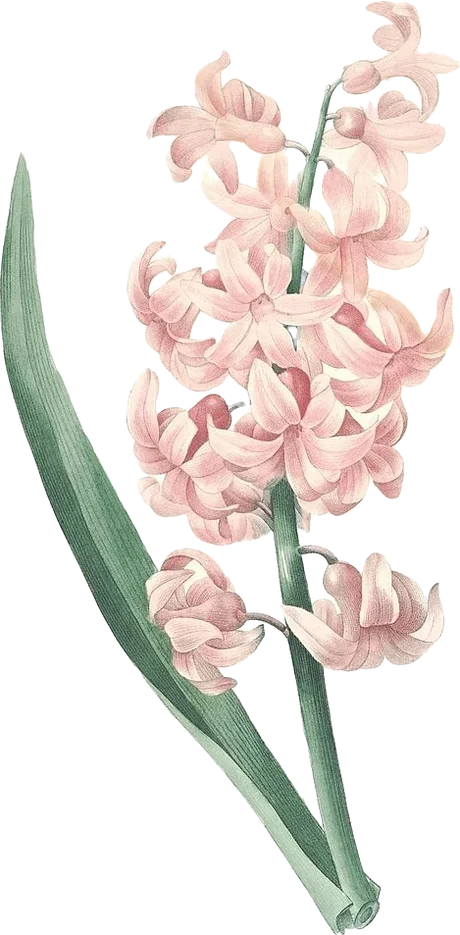
Hyacinth Meaning by Colour: Purple Means "I'm Sorry"
Garden hyacinth · Sonbol (Persian)
Botanical name: Hyacinthus orientalis · Family: Asparagaceae
The hyacinth is a dense spike of starry, intensely fragrant flowers, and one stem can scent a whole room. Its colours carry some of the most specific meanings in the language of flowers.
Create a bouquet with hyacinths →Ready in a minute — just add your message.
What it means
Pink hyacinths mean playfulness and joy, and blue ones sincerity. White means loveliness, and purple is the flower of sorrow and asking for forgiveness. A purple hyacinth is the classic "I'm sorry" flower.
What the colours mean
- Blue — sincerity and constancy
- Purple — sorrow, forgiveness and reflection
- White — quiet beauty and prayerful thought
- Pink — playfulness and affection
- Yellow — traditionally jealousy, though today often simple cheerfulness
When to give it
- To apologise (purple)
- Spring and Nowruz
- A new home
- Just because, to bring fragrance
- Birthdays (pink)
Perfect for:
Who should you give it to?
- Someone whose loyalty you value
- A person you wish to forgive or comfort
- A fragrance-loving friend
- Someone welcoming spring
When not to give it
- Purple hyacinths for a celebration, unless you mean the apology.
- Someone unwell or sensitive to scent. Hyacinths are among the most strongly scented flowers.
- Confusing it with water hyacinth (jalkumbhi), a different plant.
Short messages to send with it
Where it grows
The garden hyacinth is native to the eastern Mediterranean, from southern Turkey through Syria and Lebanon. It grows from a bulb and flowers in early spring. Dutch growers have bred it for centuries, and the Netherlands still produces most of the world's hyacinth bulbs.
How it came to India
Hyacinth is native to parts of the eastern Mediterranean and western Asia. Its bulbs circulated for centuries through Persian, Ottoman and European garden trade, then reached Indian growers through ornamental-plant exchange and nursery catalogues. A precise first introduction to India is not well documented. Since the bulb requires a cold period, gardeners in the northern hills could grow it naturally, while growers in warmer cities learned to chill imported bulbs before planting. It remains primarily a seasonal garden and pot flower rather than a traditional Indian field crop.
Where to find it in India
Hyacinths need a cool winter, so in India they are grown mainly as potted spring bulbs in the hills or in cool, air-conditioned homes. They are not to be confused with water hyacinth (jalkumbhi), the floating weed that chokes Indian lakes, which is a completely different plant.
Season and blooming time
Hyacinths flower in late winter or early spring after a period of cold. In India, bulbs perform best in the northern hills; elsewhere they are commonly chilled before planting for seasonal winter displays.
In culture
In Greek myth, Hyacinthus was a youth loved by Apollo, and a flower grew where he fell. The hyacinth (sonbol) is one of the seven items on the haft-sin table at Nowruz, the Persian New Year.
History and symbolism
The flower recalls Hyacinthus, a youth in Greek mythology whose accidental death was mourned by Apollo. That story gave hyacinths themes of remembrance, while their powerful fragrance and spring arrival also made them symbols of renewal and joyful play.
The story behind this flower
In Greek mythology, Hyacinthus was a beautiful young prince of Sparta and a beloved companion of Apollo, the god of sunlight, music, prophecy and healing. The two spent time hunting and practising athletic skills together. One day Apollo threw a discus and Hyacinthus ran to catch it. The discus struck him and caused a fatal wound. In some versions it was a tragic accident; in another, the jealous west wind Zephyrus blew the discus off course because Hyacinthus preferred Apollo. Apollo tried to use his healing powers, but even a god could not prevent the young man’s death. Refusing to let Hyacinthus be forgotten, Apollo caused a flower to rise where his blood touched the earth. Ancient descriptions may refer to a different flower from the modern garden hyacinth, and the letters said to appear on its petals belong to poetic tradition rather than botany. The emotional centre of the tale is nevertheless clear: grief seeks a form that memory can keep. The flower became associated with sorrow, constancy and affection that survives loss. Today its strong fragrance and early spring bloom add renewal to that older meaning. A hyacinth can therefore say, “I remember,” while also promising that beauty can return after a season of grief.
Did you know?
- Hyacinth bulbs can irritate the skin, so gardeners often wear gloves to handle them.
- A bulb can flower in nothing but water using a special hourglass-shaped "hyacinth glass".
- Water hyacinth (jalkumbhi) is not related to the garden hyacinth.
Questions
Which flower means I'm sorry?
The purple hyacinth, which stands for sorrow and asking for forgiveness.
What does a pink hyacinth mean?
Playfulness and joy. Good for a birthday.
What does a blue hyacinth mean?
Sincerity and constancy.
Is hyacinth the same as jalkumbhi?
No. Jalkumbhi is water hyacinth, a floating weed; garden hyacinths grow from bulbs.
What should I write with apology flowers?
Say clearly what you're sorry for, without excuses. See our guide to flowers to say sorry.
Other flowers
Illustration: Pierre-Joseph Redouté, Choix des plus belles fleurs (1827), plate 100. Public domain.