Peony Meaning: The Flower of Weddings and Good Fortune
Pivoine · King of flowers
Botanical name: Paeonia officinalis · Family: Paeoniaceae
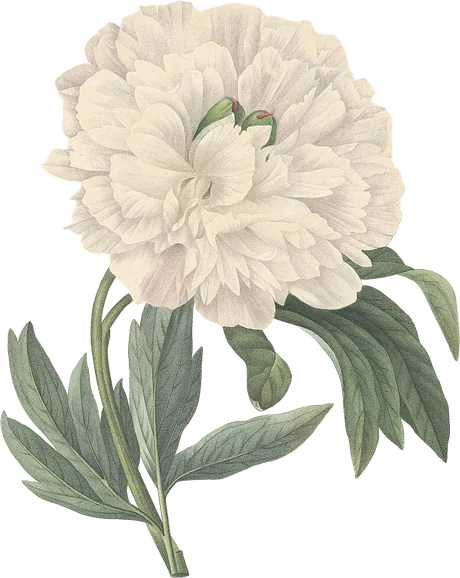
Big, soft and almost absurdly full, the peony is the flower of weddings, good fortune and romance. The plate shows the common European peony in its pale form.
Create a bouquet with peonies →Ready in a minute — just add your message.
What it means
Peonies stand for prosperity, honour, romance and a happy marriage. In China the peony is called the "king of flowers" and is linked with wealth and good fortune. A bouquet of peonies says "I wish you a beautiful life".
What the colours mean
- Pink — affection, prosperity and a happy marriage
- White — sincerity and a graceful apology
- Red — honour, passion and abundance
- Yellow — renewal and joyful new beginnings
When to give it
- Weddings and engagements
- Wedding anniversaries (the traditional 12th)
- Congratulations on something big
- A new home
- Romantic surprises
Perfect for:
Who should you give it to?
- Newlyweds or an engaged couple
- Someone moving into a new home
- A person celebrating prosperity or success
- Someone owed a sincere apology
When not to give it
- Bright peonies for sympathy. If you choose peonies for condolence, keep them white.
- Expecting fresh peonies in India out of season. They are mostly imported and expensive; a digital bouquet has no season.
Short messages to send with it
Where it grows
This peony grows wild in the mountain meadows of southern Europe, from France through Italy to the Balkans. Peonies need a properly cold winter to flower, which is why they do best in cool climates. Other species grow across Asia, and China has cultivated them for well over a thousand years.
How it came to India
The common European peony on this page is not native to the Indian plains. Peonies need a cold winter, so they entered Indian horticulture mainly as specialist temperate ornamentals rather than as a widespread traditional flower. Nursery and botanical-garden exchange introduced them to suitable Himalayan and high-altitude gardens, but there is no dependable record naming one person or year as their first arrival. India also has Himalayan plants related to cultivated peonies, which can cause origin stories to become confused. Today true peonies remain uncommon and are grown mostly where winter chill is sufficient.
Where to find it in India
Peonies won't flower in the Indian plains, because they need winter frost. India does have its own wild species, the Himalayan peony (Paeonia emodi), which grows in the forests of the western Himalaya from Kashmir to Uttarakhand. The peonies sold by Indian florists for weddings are mostly imported, which is part of why they feel so special.
Season and blooming time
Peonies have a short, eagerly awaited season. Most flower in late spring to early summer, often for only seven to ten days per plant. They need a cold winter, so in India they are best suited to Himalayan and other cool high-altitude gardens.
In culture
The peony is named after Paeon, the physician of the gods in Greek myth. In China, Luoyang holds a famous peony festival every spring, and peonies fill Chinese and Japanese painting and embroidery.
History and symbolism
The peony is named for Paeon, a healer in Greek mythology. In China it became the “king of flowers,” associated with wealth, rank and feminine beauty; its lush form later made it a favourite symbol for marriage and good fortune.
The story behind this flower
Paeon appears in Greek mythology as a young healer who studied under Asclepius, the god associated with medicine. Paeon was talented, and in one telling he discovered a healing root that could ease the suffering of a god. His success made Asclepius dangerously jealous; the teacher feared that the pupil’s skill and reputation might surpass his own. Zeus, ruler of the gods, saw the danger and protected Paeon by changing him into a flower—the peony. The transformation explains the flower’s name and its long connection with healing and protection. The tale was retold in several forms, so it should be read as mythology rather than botanical history, but its central idea remained powerful: excellence can attract envy, and gentleness sometimes needs protection from power. The peony’s later cultural life added another layer. In China, where tree peonies were cultivated and celebrated for centuries, the flower became associated with honour, prosperity and high rank. A peony bouquet therefore carries more than romantic beauty. It can recognise someone’s talent, wish them a prosperous future, or honour a person whose quiet gifts deserve to be protected and allowed to flourish.
Did you know?
- A healthy peony plant can keep flowering in the same spot for decades.
- Ants are often seen on peony buds, drawn by the sugary nectar. They don't harm the flower.
- Peonies are the traditional flower for a 12th wedding anniversary.
Questions
What do peonies symbolise?
Prosperity, honour, romance and a happy marriage. In China the peony is called the "king of flowers".
Are peonies good for a wedding gift?
Yes. Few flowers say "a happy married life" as clearly.
Which anniversary is the peony flower for?
Peonies are the traditional flower for the 12th wedding anniversary.
Can I give peonies on a birthday?
Yes. Pink peonies make a generous, romantic birthday bouquet.
Why are peonies so expensive in India?
They need cold winters to flower, so most cut peonies sold in India are imported.
Other flowers






Illustration: Pierre-Joseph Redouté, Choix des plus belles fleurs (1827), plate 4. Public domain.