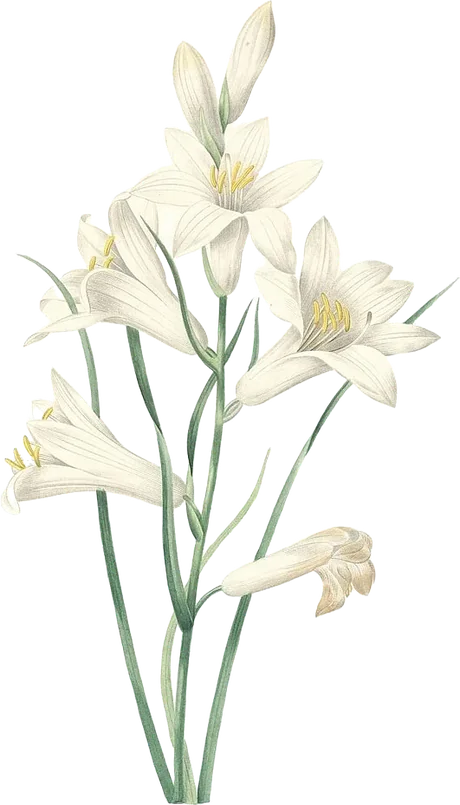
White Lily Meaning: Purity, Peace and Sympathy
White lily · Lily of purity
Botanical name: Lilium · Family: Liliaceae
Tall, white and quietly fragrant, the lily is the flower of purity, peace and remembrance. It works just as well at a wedding as it does when someone needs comfort.
Create a bouquet with lilies →Ready in a minute — just add your message.
What it means
White lilies stand for purity, innocence and peace. That is why they appear at weddings and also at funerals, where they mean that the soul is at rest. Pink lilies suggest admiration, and orange ones confidence.
What the colours mean
- White — purity, sympathy and renewal
- Pink — admiration and compassion
- Orange — confidence, energy and pride
- Yellow — gratitude, happiness and friendship
- Red — passion and romantic affection
When to give it
- Sympathy and condolence
- Weddings
- A new home
- Thanking someone you respect
- Mother's Day
Perfect for:
Who should you give it to?
- Someone marking a new beginning
- A grieving family
- A person you admire
- Newlyweds or anniversary couples
When not to give it
- Any home with cats. Every part of a lily, even the pollen, is highly toxic to them.
- Hospital rooms and people with allergies. The scent and pollen are strong.
- All-white lilies at a birthday or party, which can feel like condolence.
Short messages to send with it
Where it grows
True lilies (Lilium) grow wild across the temperate Northern Hemisphere, in Asia, Europe and North America, usually in meadows and woodland edges. The Madonna lily comes from the eastern Mediterranean. The big Asiatic and Oriental lilies sold by florists are modern hybrids, bred mostly from East Asian species.
How it came to India
“Lily” covers a large genus, and its Indian story has two parts. Several Lilium species are native to the Himalayas and northeastern India, so lilies as a group did not simply arrive from abroad. The large, colourful hybrid lilies sold by modern florists are different: breeding programmes and commercial bulb trade brought those cultivars into Indian cut-flower production. Growers in cool hill regions and protected farms learned to manage imported bulbs for weddings and bouquets. It is therefore more accurate to distinguish India’s native lilies from the modern hybrids introduced through international horticulture.
Where to find it in India
Several wild lilies grow in the Himalaya, including Lilium nepalense and Lilium wallichianum. Cut lilies are grown commercially in Himachal Pradesh, Jammu & Kashmir, the Nilgiris around Ooty, and Darjeeling, as well as in greenhouses near Bengaluru and Pune. Don't confuse it with the water lily (kumudini), which is a completely different plant.
Season and blooming time
Different lilies bloom from late spring through summer. In India, commercial lilies are grown in cool regions and under protected conditions, making cut stems available for much of the year even though their natural peak is spring and early summer.
In culture
In Christian art the white Madonna lily is the flower of the Virgin Mary, and in the West Easter lilies decorate churches in spring. Lilies appear in ancient Greek and Egyptian art too.
History and symbolism
Lilies appear in ancient Mediterranean art and later became symbols of purity and renewal in Christian tradition. In China they are associated with lasting love and are often used at weddings because their name sounds like a wish for a harmonious union.
The story behind this flower
One Greek legend connects the first lilies with Hera, queen of the gods and goddess of marriage. Her husband Zeus had fathered the infant Heracles with a mortal woman and wanted the child to receive divine strength. According to the story, the baby was brought to the sleeping Hera so that he could drink her milk. When Hera awoke and realised that the child was not her own, she pulled away. Drops of milk scattered across the heavens and became the Milky Way; those that fell to earth became white lilies. The myth gave the flower associations with motherhood, divine power and purity, although later cultures interpreted lilies in their own ways. In Christian art, the white Madonna lily appeared beside the Virgin Mary as a sign of purity and grace. In China, lilies became wedding flowers linked with a wish for a harmonious union lasting a hundred years. These traditions do not describe the botanical origin of lilies—they explain how people used a striking white flower to speak about birth, care, marriage and renewal. That layered history is why a lily can feel appropriate at both a wedding and a memorial: its story holds beginnings and endings, joy and grief, within the same elegant bloom.
Did you know?
- Lilies are very poisonous to cats. Even pollen or vase water can be dangerous, so keep real lilies away from cats.
- Lily pollen stains fabric. Florists often snip off the anthers.
- One lily stem can carry several buds that open one after another over a week or more.
Questions
What does a white lily mean?
Purity, peace and remembrance. It suits both weddings and messages of sympathy.
Are lilies good for condolence?
Yes. White lilies are one of the most common sympathy flowers around the world.
Are lilies poisonous to cats?
Yes, extremely. Even small amounts of pollen or vase water can cause kidney failure in cats.
Can I give lilies on a birthday?
Pink or coloured lilies can work; avoid all-white lilies, which can feel sombre.
Is a lily the same as a water lily?
No. The water lily (kumudini, Nymphaea) is an aquatic plant from a separate family.
Other flowers






Illustration: Pierre-Joseph Redouté, Choix des plus belles fleurs (1827), plate 18. Public domain.