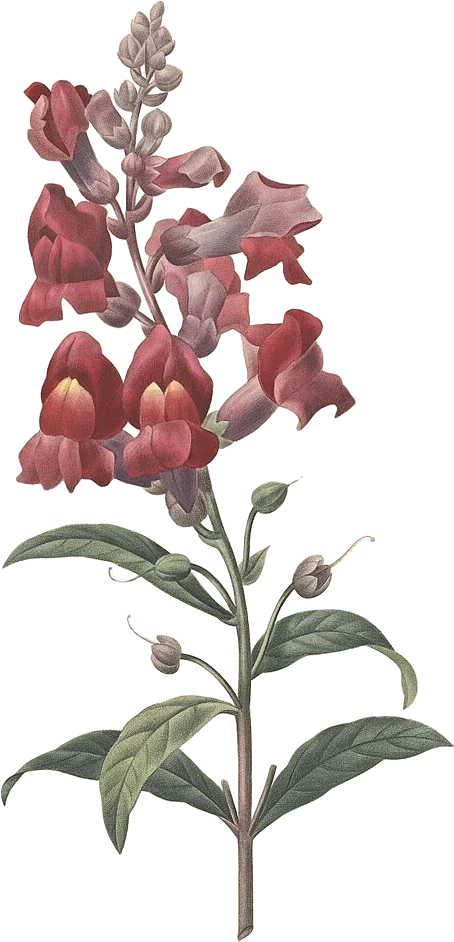
Snapdragon Meaning: Grace and Inner Strength
Antirrhinum · Dragon flower
Botanical name: Antirrhinum majus · Family: Plantaginaceae
Squeeze the side of a snapdragon flower and its "mouth" opens and snaps shut, which every child who has tried it remembers. Tall spikes in red, pink and cream make it a garden classic.
Create a bouquet with snapdragons →Ready in a minute — just add your message.
What it means
Snapdragons stand for grace under pressure and inner strength. In Victorian flower language they had a darker meaning too, deception, but today they are given as a sign of strength and charm.
What the colours mean
- Red — passion and strength
- Pink — grace and affectionate admiration
- Yellow — happiness and positive energy
- White — sincerity and innocence
- Purple — dignity and creativity
When to give it
- To someone going through a hard time
- Congratulations
- Birthdays in winter
- To a strong friend
- Cheering someone on
Perfect for:
Who should you give it to?
- Someone showing courage
- A child who enjoys playful flowers
- A performer or confident speaker
- A friend keeping a difficult promise
When not to give it
- An apology to someone whose trust you broke. In Victorian flower language snapdragons could also mean deception.
- Dried snapdragon pods for a superstitious friend. They look like tiny skulls.
Short messages to send with it
Where it grows
Snapdragons are native to the rocky Mediterranean coast, in Spain, southern France, Italy and North Africa. In the wild they often grow from cracks in walls and cliffs.
How it came to India
Snapdragon is native around the Mediterranean and parts of western Europe. Its long history as a European garden flower produced many colours and forms, and commercial seed catalogues carried those varieties worldwide. It entered Indian gardening through nursery trade, botanical collections and colonial-era flower beds, although no dependable source gives one exact arrival date. Since it prefers cool weather, Indian growers adopted it mainly as a winter annual in the plains and a summer flower in hill regions. Modern hybrids continue to arrive through the international seed trade.
Where to find it in India
Snapdragons are one of the best-loved winter flowers of north India. They are sown in September or October and flower from about January to March in gardens across Delhi, Chandigarh and Lucknow, and at winter flower shows. In the hills they flower into summer.
Season and blooming time
Snapdragons are cool-season favourites. Across North Indian plains they are generally sown in autumn and bloom through winter into spring; in cool hill climates they can flower during summer.
In culture
In old European folklore, snapdragons were believed to protect against deceit. Scientists use the snapdragon to study how flowers develop, and it has taught us a great deal about plant genetics.
History and symbolism
The flower’s “mouth” opens when its sides are squeezed, inspiring the dragon name. Ancient traditions associated snapdragons with protection and strength; Victorian flower language added grace, but also concealment because the closed bloom seemed to hide a secret.
The story behind this flower
Its botanical name, Antirrhinum, comes from Greek words meaning "like a nose", a description of the flower's snout-like shape. In old European folklore, snapdragons were protective: people hid them in their clothes or homes in the belief that they guarded against deceit and enchantment. The flower's real fame, though, came from the laboratory. In the early 20th century the German geneticist Erwin Baur used snapdragons to study inheritance, and the plant became a classic subject of genetics research. In the 1990s, scientists studying snapdragons discovered genes that control flower symmetry, explaining why a snapdragon is shaped like a face with a left and a right side rather than a perfect circle. Children have always known the flower's other secret: squeeze its sides and the dragon's mouth opens. Only heavy bees, usually bumblebees, can force their way in to the nectar. A flower that only opens for strength is a good reason it now stands for it.
Did you know?
- Only bees heavy enough to push the "mouth" open can reach the nectar, usually bumblebees.
- After the flowers fade, the seed pods look like tiny skulls.
- The snapdragon is a classic subject of plant genetics research.
Questions
What does a snapdragon mean?
Grace and inner strength, especially under pressure.
Is a snapdragon good for someone going through a hard time?
Yes. It says "you're stronger than you know".
Why is it called a snapdragon?
Squeezing the flower makes it open and shut like a dragon's mouth.
When do snapdragons bloom in India?
From about January to March in the north Indian plains.
Do snapdragons mean deception?
That was one Victorian meaning; today they are given for strength and grace.
Other flowers




Illustration: Pierre-Joseph Redouté, Choix des plus belles fleurs (1827), plate 12. Public domain.