Morning Glory Meaning: Affection and a Fresh Start
Dwarf morning glory · Belle-de-jour
Botanical name: Convolvulus tricolor · Family: Convolvulaceae
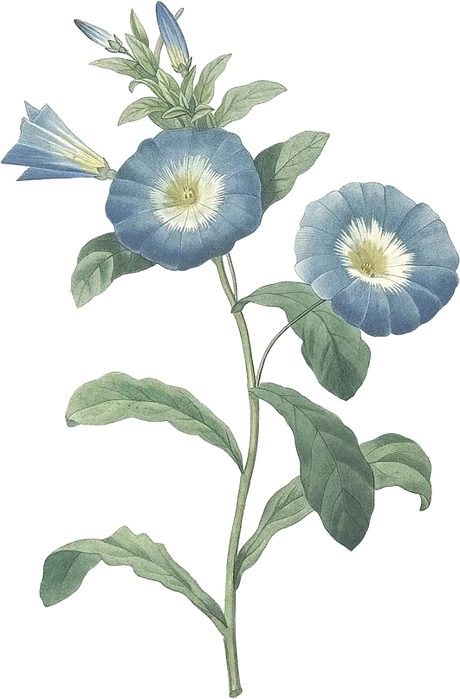
Morning glories open with the sun and fold up by afternoon, which makes them a symbol of new starts and of making the most of today. The plate shows the dwarf morning glory, with three colours in each flower.
Create a bouquet with morning glories →Ready in a minute — just add your message.
What it means
Morning glories stand for affection and new beginnings. Each flower lasts only a day, so they also remind you to enjoy the moment.
What the colours mean
- Blue — trust, peace and a fresh start
- Purple — imagination and spiritual affection
- Pink — gentle love and gratitude
- White — clarity and innocence
- Red — vitality and passionate attachment
When to give it
- Good morning wishes
- A fresh start
- Encouragement before a big day
- Friendship
- Just because
Perfect for:
Who should you give it to?
- An early riser or optimist
- Someone beginning a new routine
- A person who appreciates simple moments
- A friend embarking on a journey
When not to give it
- Sympathy messages. A one-day flower can feel too fleeting for grief.
- Promises of forever. Its message is "today", not "always". For that, choose sadabahar.
Short messages to send with it
Where it grows
The dwarf morning glory (Convolvulus tricolor) comes from the Mediterranean: southern Europe and North Africa. Its relatives in the bindweed family grow around the world, many of them as twining climbers.
How it came to India
The name morning glory covers many species, including some native or long-established in Asia. The flower illustrated on this page is Convolvulus tricolor, a Mediterranean species introduced as a garden ornamental. Seed trade made annual morning glories easy to distribute, and European-era nurseries helped spread colourful varieties through Indian gardens. Exact arrival records are scarce, partly because different climbing Ipomoea and Convolvulus species were often grouped under the same common name. Today several morning glories grow so freely in India that their separate origins are easy to overlook.
Where to find it in India
Dwarf morning glory is grown as a winter and spring annual in Indian gardens. India is also full of its relatives. Climbing Ipomoea morning glories cover fences, besharam lines roadsides, kalmi saag is a leafy vegetable, and the sweet potato belongs to the same family.
Season and blooming time
Morning glories love warmth and usually bloom from summer into autumn. In tropical India they may flower through much of the year, opening early in the day and fading as afternoon heat rises.
In culture
In Japan, asagao (morning glory) breeding became a craze in the Edo period, and children still grow morning glories as a summer school project. In Victorian England, the flower stood for affection.
History and symbolism
Because each bloom opens for only a day, morning glory often represents the precious, fleeting nature of life. In Japan, where it is called asagao, growers have cultivated remarkable forms since the Edo period and celebrate it at summer flower fairs.
The story behind this flower
Morning glories reached Japan more than a thousand years ago, not as ornaments but as medicine: their seeds were used as a laxative. By the Edo period, gardeners had discovered that the plants threw up strange mutations, flowers with frilled, split or feathery petals, and leaves of odd shapes. In the early 19th century, around Edo (today's Tokyo), a craze for these "changed" morning glories swept the city. Samurai, merchants and townspeople bred them, published illustrated catalogues and held competitions, and rare varieties changed hands for large sums. Because many of the strangest forms couldn't set seed themselves, growers had to keep their sister plants and track inheritance carefully: a kind of practical genetics, long before Mendel. The tradition never disappeared. Every summer, Tokyo still holds morning glory fairs, and Japanese schoolchildren grow asagao in pots to learn how plants work. The dwarf morning glory shown here is a Mediterranean cousin, but it shares the family habit: a new flower, every single morning.
Did you know?
- Each flower opens in the morning and usually closes by afternoon.
- Convolvulus comes from the Latin convolvere, "to twine".
- Its three-coloured flowers are blue at the rim, white in the middle and yellow at the heart.
Questions
What does a morning glory mean?
Affection, new beginnings and enjoying today.
Why do morning glories close in the afternoon?
Each flower lasts only one day; it opens with morning light and closes as the day warms.
Is a morning glory good for a get-well gift?
Yes. It says each day is a fresh start.
Is kalmi saag a morning glory?
Yes. Kalmi (water spinach) is an Ipomoea in the morning glory family.
What is the Japanese morning glory?
Asagao, a close cousin that became a craze in Edo-period Japan.
Other flowers





Illustration: Pierre-Joseph Redouté, Choix des plus belles fleurs (1827), plate 50. Public domain.